
Introduction
Diamond cut plays one of the biggest roles in determining a diamond’s brilliance, sparkle, and overall beauty. When shopping for diamonds, you may come across terms like Ideal Cut and Excellent Cut, but these terms can have different meanings depending on the grading laboratory.
This guide explains the difference between Ideal and Excellent cut diamonds, how cut quality affects light performance, and what to consider when choosing the right diamond.
Key Takeaways
- Diamond cut directly affects brightness, fire, and sparkle.
- Ideal and Excellent cut diamonds both represent high-quality diamonds.
- Cut terminology can vary between grading laboratories.
- GIA uses Excellent as its highest standard cut grade for round brilliant diamonds.
- IGI uses Excellent-Ideal as its top cut grade for round brilliant diamonds.
- The best diamond choice depends on certification, proportions, appearance, and budget.
Ideal vs. Excellent Cut Diamond Comparison
| Feature | Ideal Cut Diamond | Excellent Cut Diamond |
| Cut Quality | Premium cut quality | Premium cut quality |
| Light Performance | Exceptional light return | Excellent light return |
| Brilliance | Very high sparkle | Very high sparkle |
| Proportions | Often selected within tighter parameters | Can include a wider range of proportions |
| Availability | Depends on grading system | More commonly used grading term |
| Price | May carry a premium | Often provides excellent valu |

What Is an Ideal Cut Diamond?
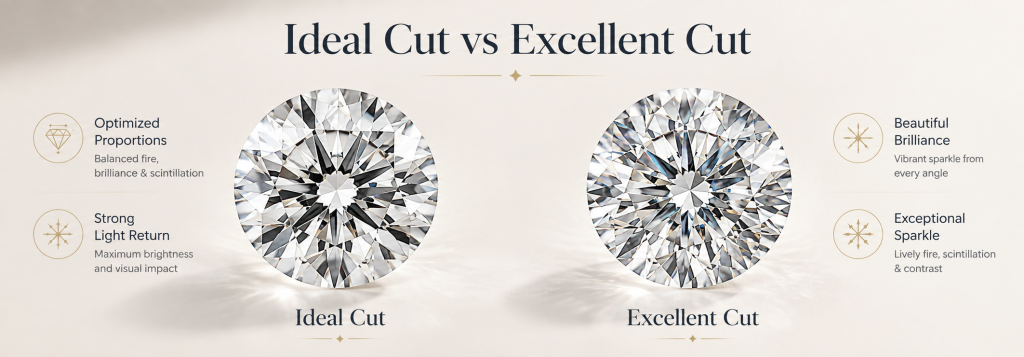
An Ideal cut diamond generally refers to a diamond with highly optimized proportions, symmetry, and light performance. These diamonds are designed to maximize brightness, fire, sparkle, and light return.
The exact meaning of Ideal depends on the grading system being used.
What Is an Excellent Cut Diamond?
An Excellent cut diamond represents the highest standard cut grade used by GIA for round brilliant diamonds. These diamonds are evaluated for proportions, symmetry, polish, and light performance. Two Excellent cut diamonds can still look slightly different because the category includes a range of proportion combinations

What Is Diamond Cut and Why Does It Matter?
Diamond cut describes how well a diamond’s facets, angles, symmetry, and polish interact with light. A well-cut diamond allows more light to return through the top of the stone, creating a brighter and more sparkling appearance.
Diamond Shape = Appearance (Round, Oval, Pear, Emerald)
Diamond Cut = Light Performance (Proportions, Facets, Symmetry, Polish)

How Are Diamond Cuts Graded?
Diamond laboratories evaluate cut quality using factors such as proportions, symmetry, polish, facet arrangement, and light performance. The grading terminology depends on the laboratory.
GIA Round Brilliant Cut Scale:
Excellent → Very Good → Good → Fair → Poor
IGI Round Brilliant Cut:
Excellent-Ideal → Excellent → Very Good → Good → Fair
How Cut Quality Affects Diamond Sparkle
- Brightness: The amount of white light reflected from the diamond.
- Fire: The colorful flashes created when light disperses through the diamond.
- Scintillation: The sparkle pattern created when the diamond moves.
Which Should You Choose: Ideal or Excellent?
Both Ideal and Excellent cut diamonds can offer exceptional beauty. Instead of choosing only based on the grade name, consider certification, proportions, symmetry, polish, light performance, and budget.
If maximum precision and light performance are your priority, an Ideal-quality diamond may be the right choice. If you want excellent sparkle while balancing size, quality, and price, an Excellent cut diamond can be an outstanding option.
Find Your Perfect Diamond
Find the diamond that shines beautifully from every angle. Explore Dazzolite diamonds and engagement rings to compare certified diamonds by cut, carat, color, clarity, and shape.
